What Are the Boundaries in Modern Production Processes When AI Agents Like Cline Can Read Codebases, Fix Bugs, and Automatically Deploy to Cloud Platforms?

I. The Reality in 2026: How Far Have AI Agents Really Come?
A common misconception in today’s tech community is that AI agents such as Cline can completely replace software developers across the entire software development lifecycle. The harsh truth is far more nuanced: the ability of agents to read codebases, fix bugs automatically, and deploy to cloud platforms covers only a short segment of the full production pipeline — a segment strictly bounded by rigid rules set by the organization.
Key Takeaway: AI Agents excel at “structured execution,” but falter at “business-impact decision-making.”
A notable data point: according to the DORA State of DevOps 2025 report (Google Cloud), organizations using AI coding assistants at a moderate level saw only a 3–5% reduction in lead time for changes, not the 30–50% often inflated in marketing materials. The reason lies precisely in the boundary this article will dissect.
II. Deconstructing the Operating Mechanism of AI Agents
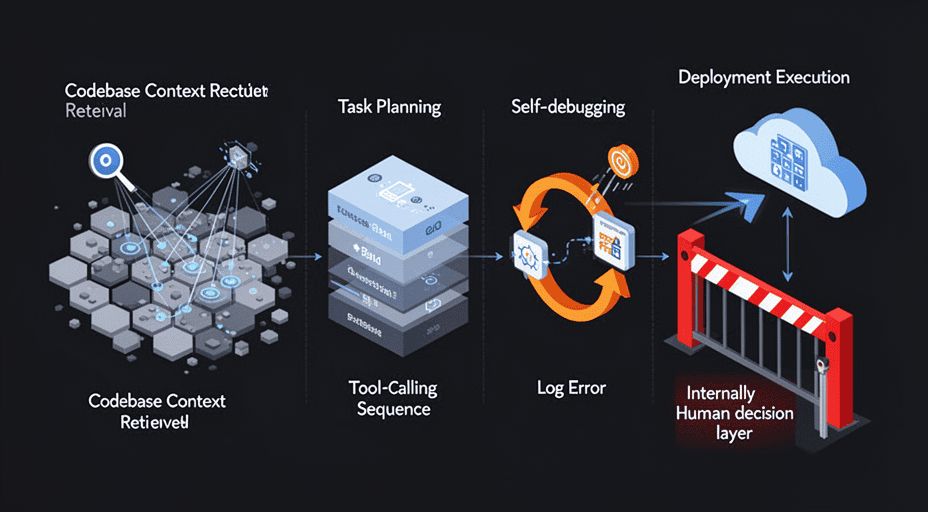
To understand the boundaries, we must first understand what agents do at the mechanistic level. A typical AI agent like Cline operates through four core components.
2.1. Context Retrieval
Agents do not “know” the codebase. They rely on vector indexing or grep-based search to extract code snippets relevant to a request. This is a fundamental weakness: agents see only what the retrieval system shows them, lacking the holistic, long-term understanding that an engineer gains after years of working with a project.
2.2. Task Planning
After gathering context, the agent breaks down the request into small steps via a tool calling sequence: read file, modify file, run tests, call cloud API. This works well when the task has clear input-output definitions, such as refactoring a single function or adding a new REST endpoint.
2.3. Self-Debugging Loop
The agent executes commands, reads error logs, analyzes failures, adjusts code, and repeats. This loop is highly effective for syntax errors and test failures with clear stack traces, but nearly helpless when dealing with business logic errors or race conditions in distributed systems.
2.4. Cloud Deployment Execution
Through CLI or SDK, the agent can invoke infrastructure as code (Terraform, Pulumi) or container orchestration (Kubernetes, ECS) to push new code to environments. This is the most dangerous layer, as a single wrong command could delete a production database.
III. Redesigning the Production Architecture: The Real Role of AI Agents
When these four mechanisms are integrated into a real production pipeline, the boundaries become clear. It’s not the tool that defines the boundary, but the control mechanisms organizations build around it.
3.1. Architectural Decision Layer
Agents cannot and should not decide on database selection, message broker configuration, or schema migration design. These decisions carry extremely high reversal costs and require deep understanding of long-term business strategy.
3.2. Code Review Layer
Even when agents generate code, human code review remains essential. Agents don’t understand team-specific coding conventions, cannot assess existing technical debt, and do not bear legal responsibility for the code they produce.
3.3. Deployment Gate
In a standard model, agents are allowed to push code only to staging environments, never directly to production. Access to production requires approval — at minimum — from a senior engineer. This gate can be automated based on criteria such as test pass status, clean security scanning, and meeting performance budgets.
3.4. Post-Deployment Monitoring Layer
After production deployment, observability systems (logging, tracing, metrics) must detect anomalies. Agents are ill-suited to respond to production incidents, as such responses demand real customer context and the authority to decide on rollback.
IV. Execution Strategy in Organizations
This section presents how a hypothetical fintech organization integrates AI agents into their workflow without losing control.
4.1. Hypothetical Business Context
A mid-sized fintech company processing payments, operating twenty microservices on AWS, with a team of roughly thirty engineers. Their goal is to reduce incident response time and PR review duration, without violating financial regulatory requirements.
4.2. How the AI Agent Is Integrated
The engineering team deploys Cline with three hard rules. First, the agent has read-only access to the entire repository, and write access only to branches prefixed with ai/. Second, all pull requests created by the agent must include annotated diffs so reviewers can understand intent. Third, the agent never receives direct deployment commands to production; instead, it generates GitHub Actions workflow drafts that require human initiation.
4.3. Actual Operational Workflow
When a bug is reported, the on-call engineer pastes logs into the agent and requests root cause analysis. The agent analyzes relevant code and proposes a patch. The engineer confirms, then instructs the agent to create a PR. The PR enters an automated CI/CD pipeline running unit tests, integration tests, and security scans. If all checks pass, the engineer performs a manual review, merges the PR, and the system automatically deploys to a canary environment before full rollout.
4.4. Operational Outcomes
According to the engineering team (data not fully disclosed as this is a simulated case), three changes were clearly observed. Patch drafting speed improved significantly because the agent handles boilerplate tasks. Human review workload decreased as the agent already eliminated most syntax errors. Most importantly, the blast radius of mistakes was minimized because the agent cannot directly access production traffic.
Expert Note: Boundaries should not be defined by “what the agent can do,” but by “what the agent can touch.” Allowing agents to fix code is acceptable as long as they cannot directly interact with production traffic.
V. Solution Comparison Table and Safety Scorecard
5.1. Comparison of Popular AI Coding Agents in 2026
| Criteria | Cline | GitHub Copilot Workspace | Cursor Composer | Devin |
|---|---|---|---|---|
| IDE Integration | VS Code (extension) | Web + IDE | Dedicated IDE | Web platform |
| Codebase Access | Read entire local repo | Read GitHub repo | Read local + remote repo | Read repo via API |
| Run terminal commands | Yes (with approval) | No | Yes (sandbox) | Yes (sandbox) |
| Direct cloud deployment | Via third-party CLI | Not supported | Via terminal | Yes (virtual sandbox) |
| Autonomy Level | Medium, requires approval | Low, suggestion-only | Medium to high | High, end-to-end |
| Suitability for large teams | High | High | Medium | Medium |
5.2. Safety Scorecard for Production Readiness
| Criteria | Score | Notes |
|---|---|---|
| Access Control (Permission scoping) | 7 | Requires strict sandboxing; prone to over-permission if misconfigured |
| Action Traceability (Audit trail) | 6 | Logs exist but lack detail for financial compliance |
| Incident Response Speed (Automatic rollback) | 5 | Mostly requires manual intervention |
| Agent Autonomy Level | 8 | Cline allows deep customization of approval steps |
| Sensitive Data Safety (Data safety) | 4 | Secrets must be fully isolated from agent context |
| Integration with Existing CI/CD | 7 | Works well with GitHub Actions or GitLab CI |
| Scalability Across Team Size | 6 | Difficult to manage at teams larger than twenty |
| Average Score | 6.1 | Fair rating — acceptable for non-critical workflows |
Scoring Explanation:
- 1–4 points: Low. System has significant vulnerabilities; not reliable for critical production use.
- 5–8 points: Fair. Can be piloted in non-sensitive environments with close monitoring.
- 9–10 points: Excellent. Ready for production with high autonomy.
Key Insight: No criteria reached “Excellent.” This accurately reflects that AI agent technology in 2026 still requires a human-in-the-loop as the final safety layer.
VI. Trend Forecast and Conclusion
Three clear trends will shape AI agent boundaries in the next two years. First, policy-as-code will become the default control layer: agents will only act within policy-defined boundaries, with violations blocked automatically. Second, attestation mechanisms (action certification) will be more deeply integrated, enabling traceability from each line of agent-generated code back to the original request ticket. Third, specialized agents will replace general-purpose agents in high-compliance domains such as healthcare, finance, and aviation.
6.1. The Ultimate Boundary
The real boundary does not lie in technology, but in accountability. When production goes down, customers don’t care what the AI agent did — they care who approved it. Therefore, no matter how advanced agents become, the human role in setting control gates remains irreplaceable.
6.2. Actionable Recommendations for Engineering Teams
Start with the lowest-risk tasks: writing unit tests, refactoring legacy code, generating documentation. Measure impact using cycle time and defect escape rate, not gut feeling. Gradually expand scope as the team becomes comfortable with the approval mechanism. Most importantly, never allow the AI agent to become a “black box” the team doesn’t understand.
6.3. Conclusion
AI agents like Cline have changed how code is written — but not who is responsible for it. The boundary in modern 2026 production processes remains clear: agents own execution, humans retain decision-making. Any organization that blurs this boundary will pay the price in outages, not productivity.
Related Posts

Why the Business Models of AI Apps Like OpenClaw, Hermes, and MCP Platforms Are Driving a Shift from the App Economy to the Agent Economy?
Three Latest Data Attack Vectors on AI Systems That Every Business Owner Must Know Before Delegating Control to Open-Source Models

Can AI Self-Evaluation Radically Transform the Way We Monitor Systems?
Cost Revolution: Why New Generation AI Chips Make On-Premise the 'Gold Standard' in 2026?

When 100,000 Private Conversations Leak in Just One Day: What Governance Lessons Must SMEs Learn by 2026?