How Can Small Brands Develop a Multi-Platform Strategy Without Diluting Their Budget or Message?
I. Introduction & Context 2025-2026
We are entering the era of Attention Fragmentation.
In 2025, users no longer browse the web on a single screen. They scroll through TikTok while cooking, listen to podcasts while working out, and read LinkedIn while waiting for the bus.
For small brands (SMEs), this is both an opportunity and a pitfall. The opportunity is to reach customers at every touchpoint. The pitfall is the “spray and pray” mentality.
The consequences? Budgets are blown. Content is disjointed. Messages are distorted.
The reality in 2026: Algorithms have become smarter. They penalize bland, copy-pasted content and favor Native Content (original content that fits the platform’s tone).
Small brands cannot compete on quantity with the big players. They must compete through “smart optimization.”
Key Takeaways: The issue is not where you should appear. The issue is how to appear everywhere without tripling your workforce.
II. Root Cause Analysis (Applying First Principles)
To solve the multi-platform puzzle without diluting your budget, break down the problem to its most fundamental elements (First Principles).
Why do we fear multi-platform?
1. Fear of Cost: Running ads on 5 platforms multiplies the budget by 5.
2. Fear of Exhaustion: Writing unique content for Facebook, Instagram, TikTok is overwhelming.
3. Fear of Inconsistency: Different messages on different platforms confuse customers.
This is “Linear Thinking”: 1 platform = 1 content = 1 cost.
First Principles thinking sees it differently. Brands don’t create “content for Facebook.” Brands create “Core Value.”
The rest is just technique: Packaging that value into different formats suitable for each platform’s “operating system.”
The Root of Waste: Waste comes from re-creation instead of repurposing.
You write a 2000-word blog post. Then you write a TikTok script from scratch. Then you design a completely new infographic. This is a critical mistake.
In 2026, the strategy of the winners is Content Atomization. Break a large piece of content into small atoms and distribute them widely.
Key Takeaways: Don’t think of multi-platform as “doing many things.” Think of it as “breaking down a big task and distributing it.”
III. Detailed Execution Strategy
This is the core section. We will build an Automation-first and Visual-first process for you to implement immediately.
1. Building the “Hub-and-Spoke” Content Model
Imagine a wheel. The hub: Contains long-form, deep, high-value content. This is your “owned media.” The spokes: Are social media channels like Facebook, TikTok, LinkedIn, X.
Golden Rule: Invest 80% of your creative energy into the hub. The remaining 20% is just reformatting that content for the spokes.
Practical Example: You sell a marketing course.
- Hub (YouTube/Blog): Create a 20-minute video analyzing “2026 Funnel Strategy” in depth. This is a long-term asset.
- Spoke 1 (TikTok/Reels): Cut 3 30-second “crucial” segments from the video. Add trendy captions.
- Spoke 2 (LinkedIn): Convert the video transcript into a 500-word text post, sharing expert insights.
- Spoke 3 (X - Twitter): Quote 3 golden sentences from the video, redesign them as image quotes.
You see? You only create once but reach four places.
2. Diagramming the Workflow
To prevent message dilution, you need a tight process. Here is the standard process for a small brand in 2026.
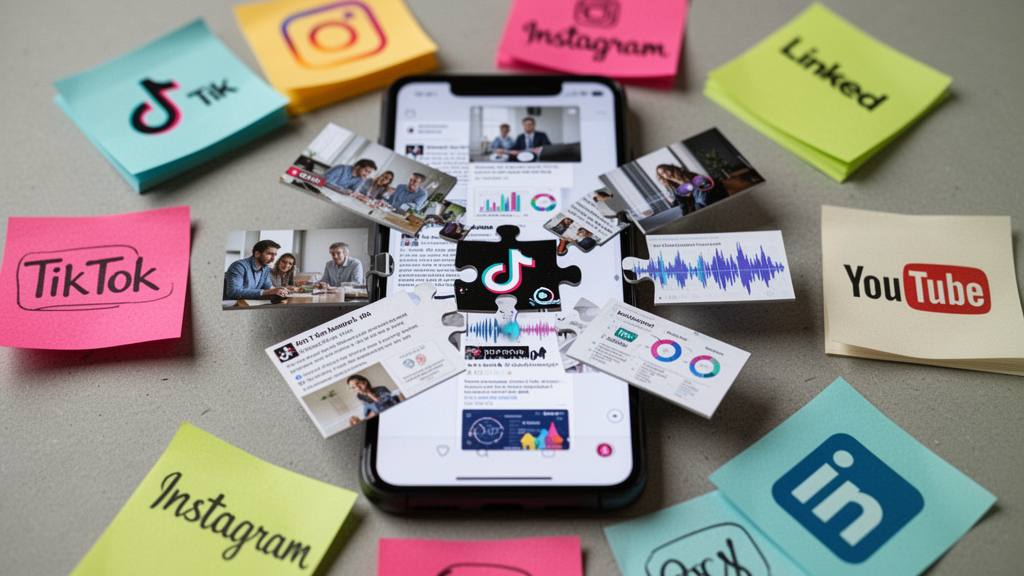
Step 1: Establish a Content Supply Chain Don’t start by writing captions. Begin with a structural mindset. Define 3 main topic pillars (Pillar Content) you want to dominate this quarter. This ensures that no matter where you post, the core message remains consistent.
Step 2: Produce “Big Rocks” Spend 2 days each month producing 4 “Big Rocks.” These could be 4 long YouTube videos, 4 in-depth blog posts, or 4 podcasts. Here, quality is paramount. Use an AI Writing Assistant to edit the scripts for sharpness.
Step 3: “Smash and Adapt” Process This is where you apply practical thinking. Use tools (like CapCut, Premiere) or AI to automate editing.
- Expert Tip: Never use the same video file for both YouTube (landscape) and TikTok (vertical). TikBot’s current algorithm can detect cropped landscape videos and reduce their priority (shadowban). You must separate the audio track and re-edit the visuals.
Step 4: Contextual Optimization Many small brands fail at this step. They copy and paste captions from Facebook to LinkedIn. Mistake. Facebook uses casual language and lots of icons. LinkedIn requires a professional tone, using data and business language. The core insight is the same, but the “packaging” (tone of voice) must change according to the “culture” of each platform.
3. Leveraging AI for Cross-Posting Automation
In 2026, manual posting is a waste of resources. You need a suite of automation tools (like Zapier, Make.com, or native schedulers from Buffer/Hootsuite).
Set up the workflow:
- Trigger: When a new video appears on your YouTube Channel.
- Action 1: Automatically fetch the title and description -> Send to ChatGPT to rewrite it into a Twitter thread style.
- Action 2: Automatically post to LinkedIn with a professional tone.
- Action 3: Automatically create a post for Facebook Groups.
This helps you maintain continuous presence without logging into 10 apps every day.
4. Implementation Strategy: 70/20/10 Rule
To avoid budget dilution, apply this resource allocation rule for multi-platform:
- 70% Organic Content: Reused content from the hub, posted for free on the spokes. The goal is to build Trust and Authority.
- 20% Community Engagement: Reply to comments, post in relevant groups. This is the cheapest way to generate traffic.
- 10% Paid Amplification: Run ads. Don’t just run ads randomly. Use this small budget to “boost” content (YouTube videos/blogs) that is performing well (high retention). Don’t run ads for short-term spokes.
Key Takeaways: Don’t let algorithms decide your destiny. Use ads to control who sees your core content, not just to buy superficial likes.
IV. Comparison and Effectiveness Evaluation
To better understand the differences between approaches, I have compared two common strategies.
Table 1: Multi-Platform Strategy Comparison
| Criterion | ”Copy-Paste” Strategy (Old) | “Content Atomization” Strategy (New) |
|---|---|---|
| Creative Effort | Very High (Rewriting content for each channel) | Moderate (Focus on Hub, reuse on Spokes) |
| Message Consistency | Low (Easily misaligned due to repeated writing) | High (Derived from a single source of truth) |
| SEO Effectiveness | Low (Disjointed content, lack of interlinking) | High (Internal backlinks, supports Hub ranking) |
| Production Cost | Very High (Requires many editors/writers) | Optimized (Utilizes AI and editing tools) |
| Viral Potential | Variable (Dependent on random trends) | Stable (Quick testing of multiple formats from one content) |
| Budget Suitability | Suitable for Large Brands | Suitable for SMEs and Startups |
Table 2: Strategy Effectiveness Scorecard (Scale 1-10)
Here is a detailed scorecard to help you evaluate (audit) your current strategy.
| Criterion | Score | Notes |
|---|---|---|
| Brand Consistency | 7 | Message is clear but tone of voice is inconsistent between LinkedIn and TikTok. |
| Cost Efficiency | 4 | Too much time wasted on creating entirely new content. |
| Organic Reach | 8 | Good engagement but not converting traffic to the website. |
| Production Speed | 3 | Very slow. Takes 3 days to complete a set of content for 3 channels. |
| Core Content Quality | 9 | Hub content is deep and professional, a strong point. |
| Repurposability | 2 | Rarely reuse old content, often discarded after one post. |
| Automation Level | 5 | Using scheduling tools but not connected to AI workflows. |
| Platform Insight | 8 | Understand what customers like on each platform but not serving it quickly. |
Overall Score:
- Total Score: 46/80 (Average).
Classification by 10-Point Scale:
- 1-4 Points (Low): Needs complete restructuring of the process.
- 5-8 Points (Average): On the right path but needs optimization of speed and tools.
- 9-10 Points (Excellent): Automated system, high ROI, maintenance and minor improvements needed.
Conclusion: With a score of 5.75 (average), your strategy is “Average.” You have good content (score 9) but are being drowned by manual processes (score 3) and budget wastage (score 4).
V. Future Trends Forecast & Conclusion
Looking ahead to 2026 and beyond, the boundaries between platforms will blur. The trend of Social Search will replace Google in many lifestyle sectors. TikTok is becoming a massive search engine.
Small brands without a multi-platform strategy will be like “shops in a dead-end alley.” No matter how good the products, if there are no signposts (indicators) on the main roads (platforms), customers won’t find them.
However, “signposts” don’t have to be expensive, large billboards. They can be small, subtle indicators that appear frequently (ubiquitously).
Final Advice: Don’t try to be the “king” on every platform. Choose one hub as your “capital” (where you truly own the customer). Then use Content Atomization to build “outposts” (spokes) around it.
When a small brand can tell a “good story” through “multiple voices” that are appropriate for different platforms, that is the true art of a sustainable multi-platform strategy.
Start optimizing one “Big Rock” today.
Related Posts

Why the Paid Challenge Model in 5-21 Days Has Become the Optimal Strategy for Solo Creators to Turn Expertise into Ongoing Revenue?

Automation vs. Authenticity: Analyzing the Strategy for Maintaining Authentic Interactions in the AI Era
Breaking Down Subscription Business: From Creator Economy to Super-Community
Building the Endless Video Machine: Dominating Multi-platform Automation Strategy in 2026

How a Single Individual Can Build Passive Income of $5,000–$50,000 Per Month by Combining Paid Communities and Paid Challenges