How to Build an AI Native Automation Strategy Instead of Just Connecting APIs?

When a Perfect Pipeline Still Clogs Up Your Business
Have you ever seen an automation pipeline meticulously designed, with every API seamlessly connected and data flowing smoothly from point A to point B—yet still ending in chaos? Invoices sent to the wrong address, customer responses to VIPs written in the same tone as trial users, or a five-figure order stuck due to an SKU conflict with a promotional product. All passed dozens of API validation steps but failed at the very edge of real business logic.
The root problem stems from a common misconception: viewing automation as a story of connectivity rather than a story of judgment. Hundreds of iPaaS or low-code/no-code platforms today let you draw a beautiful data flow in minutes. But if every branching decision is hardcoded or based on simple if-this-then-that rules, you’re building a machine that only knows how to run, not how to react. When the environment changes—a non-standard email format, a misspelled file, or a customer request beyond predefined scenarios—the entire system collapses or silently produces incorrect outputs.
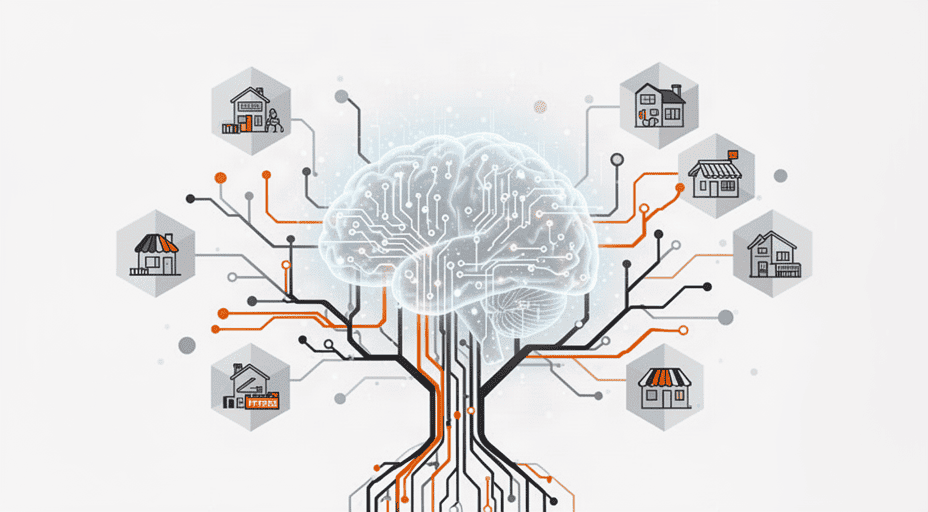
By 2026, these “connect-only” machines are becoming obsolete. System automation has moved to a new battlefield: the capacity for reasoning and adaptation within the execution flow. This is the approach we call AI native automation—where large language models (LLMs), contextual memory, and feedback loops become the brain, not just another node in the pipeline.
The Essence of an Intelligent Automation System
To move beyond API connections, we need to deconstruct the structure of any business decision. At its core, every automated task revolves around four steps: recognizing input data, determining the required action, executing that action, and verifying the result. Pure APIs efficiently handle data transfer and function triggering but leave two crucial phases open: “understanding” and “validation.”
From Raw Data to Semantic Information
A customer’s complaint email is not merely a string of characters. It carries emotional tone, hidden urgency, scattered product details, and purchase history. Similarly, a webhook receiving JSON from a POS machine: a 20% discount could indicate a membership program or a data entry error. Without semantic analysis, the system sees only key-value pairs. APIs transport data; AI native automation must extract intent and entities from that data stream.
Decisions Based on Context, Not Rigid Rules
This is the crucial point. Every integration platform allows for branching logic: “if total amount > 10 million, send to manager; otherwise, auto-approve.” But in reality, a 9-million-đồng order from a new customer differs entirely from a 9-million-đồng order from a long-term partner under a free-trial campaign. Hard rules cannot handle the multidimensionality of context. An AI model, guided by a well-crafted prompt, can simultaneously weigh over ten variables (value, customer reliability, purchase frequency, inventory levels, current policies) to make decisions like “approve tier A,” “send alert,” or “escalate to senior staff.” It doesn’t replace business logic—it elevates it into a flexible reasoning process.
Flexible Actions Beyond Available APIs
API integration assumes that every action is predefined as an endpoint. But in real environments, you sometimes need to generate a report from three sources, reformat it using a template, and enter it into an old ERP system without a REST API. An AI native agent can combine API calls with browser automation, generate temporary scripts, or even navigate the UI of legacy software. The ability to synthesize actions beyond a fixed list of endpoints is the key factor in handling broken workflows where pure integration tools give up.
Feedback Loop for Self-Correction
An API pipeline usually ends when data is successfully sent—HTTP 200 is the final victory. But technical success isn’t business success. The AI native system needs an evaluation loop: did the action just performed achieve the intended goal? If AI sent a customer reply, was the customer satisfied? Is further communication needed? If it flagged a transaction as fraud, is the probability high enough to justify locking an account immediately? It’s precisely this mechanism—collecting backward signals (human feedback, logging, 24-hour comparison with ground truth)—that tunes prompts or fine-tunes models, enabling continuous improvement instead of executing rigid, unchanging rules.
Designing an AI Native Automation Architecture from Scratch
Now that we understand its essence, designing the system isn’t about picking an “AI automation” tool—it’s about defining information, reasoning logic, possible actions, and learning mechanisms. Approach it through functional layers.
Define the Right Problem and Responsibility Boundaries
Not every process needs AI. Tasks that can be fully described by static flowcharts, have no input variability, and require no multidimensional reasoning are better served by rule engines or simple scripts to reduce costs. Identify decision points requiring “judgment”: classifying unstructured text, risk assessment, information synthesis, or multi-turn conversations. These are ideal candidates for an “AI node.”
Selecting Model and Tools Based on Reasoning Capabilities
In 2025–2026, the LLM landscape is highly diverse, from commercial models like GPT-4o, Gemini, and Claude Sonnet to open-source ones like Llama 4 and Mistral Large. The key isn’t choosing the most powerful model, but aligning reasoning ability with decision complexity. For simple classification tasks, a small language model (SLM) can run on-premise at 1/50 the cost of an external API call. For tasks requiring complex chain-of-thought reasoning, larger models are necessary. Additionally, components such as vector databases for business knowledge storage, orchestration frameworks (LangGraph, Haystack) for managing conversation state and tools, and guardrail libraries to prevent incorrect outputs must be considered from the outset.
Building a Pipeline with Full Observability
Unlike traditional API pipelines that only log status codes, AI native pipelines must record every model decision: which prompt was used, where context was retrieved from, what tokens were generated, and the confidence score of the output. Observability tools like LangSmith, Arize, or Parea AI enable real-time tracking of the system’s “thinking.” If a decision is incorrect, you can precisely trace which input message or data snippet led the AI off track—replacing guesswork with debugging precision, unlike the black-box nature of rule-based systems.
When Dirty Data Defeats a Sophisticated Model

A Real-World Deployment Scenario in a Retail Company
Consider RetailCo—a chain of 200 fashion stores, processing hundreds of customer complaints daily via email, chatbots, and social media. Their 30-member customer service team is constantly overwhelmed. In early 2025, they deployed automation by connecting Zendesk to Slack and their ERP via Zapier: complaints were automatically tagged using keywords, related orders retrieved, and alerts pushed to the relevant Slack channel. The pipeline ran flawlessly for two weeks, with zero API errors. Yet, response inaccuracy and delays didn’t improve.
Why? Many complaints didn’t include clear order IDs or referenced multiple products in a single email. Some used sarcastic language misclassified as positive by keyword-based filters. Staff still had to read every email, juggle between tabs, and manually search CRM for missing customer details. The “integration” system reduced only a few mouse clicks—not cognitive load.
Switching to an AI native architecture, RetailCo replaced keyword tagging with an LLM classifier capable of reading the entire email, extracting specific products (even with abbreviated names), classifying severity (damaged packaging, late delivery, staff attitude), and suggesting three pre-drafted responses with appropriate tone. A tool-calling agent automatically checked inventory to decide whether to process an exchange or issue a refund and integrated an approval flow for high-value orders. Everything ran on an orchestration platform that maintained the conversation state across email, chatbot, and phone calls, eliminating the need for customers to repeat information.
A feedback loop was established: after the agent sent a response, if the customer replied “ok thanks,” the system logged it as successful. Negative replies triggered automatic escalation to agents. Escalation data was collected weekly to refine prompts. After three months: average processing time dropped significantly; staff only intervened in complex cases; customer satisfaction improved without increasing headcount.
The takeaway: success isn’t measured by how many APIs you’ve connected, but by transforming a messy email into the correct business action. AI is the layer of translation and decision-making between technical systems.
Comparison of Capabilities Across Different Approaches
| Criterion | Rule-Based Automation | Pure API Integration Automation | AI Native Automation |
|---|---|---|---|
| Handling unstructured data (email, dialogue, image) | Not supported; requires manual normalization | Transmits raw data only, no analysis | Understands semantics, extracts entities and intent |
| Context-driven decision making | Based on rigid if-else rules, inflexible | Depends on external application logic outside pipeline | Multidimensional reasoning via prompt and internal knowledge |
| Adaptability to exceptions | Fails immediately on new scenarios | API errors, pipeline stops | Tries alternative approaches, asks for confirmation if uncertain |
| Integration of non-API actions | None | Limited to available endpoints | Can use browser automation, generate scripts, operate UI |
| Learning and improvement mechanisms | Manual rule updates | None, requires reprogramming | Continuous feedback loop, prompt tuning or fine-tuning |
| Operational cost for complex tasks | Very high due to human oversight | Moderate, still requires human handling of exceptions | Lower labor cost; includes model inference cost but better optimized |
The table reveals that the key difference lies not in connectivity, but in whether the system understands what it’s doing. AI native automation doesn’t replace API—it wraps a layer of cognition around APIs.
Assessing Readiness for AI Native Automation Deployment
To illustrate for companies like RetailCo, here’s a scorecard evaluating an AI native project based on practical feasibility criteria (scale 1–10).
| Criterion | Score | Notes |
|---|---|---|
| Clarity of business problem | 8 | Goal to reduce complaint handling time is quantified, but complex branches still need to be separated. |
| Quality of training data / initial prompt | 6 | Historical ticket data is available but contains many mislabeled samples, requiring cleaning before few-shot learning. |
| Ability to integrate existing systems (ERP, CRM) | 7 | 10-year-old ERP has limited REST API; must add browser automation for certain functions. |
| Technical capability of internal team | 5 | IT team is familiar with web development but new to LLMOps; requires early partnership or intensive training. |
| Organizational risk tolerance (AI errors) | 7 | Leadership accepts controlled trials; human approval loop remains for high-value transactions. |
| Scalability of model (request volume, cost) | 9 | Cloud infrastructure ready; smaller models can be self-hosted to reduce inference cost for common tasks. |
| Availability of evaluation and observability tools | 8 | Using LangSmith for tracing, combined with a custom dashboard to track correct decision rate after 24 hours. |
Average score: 7.1/10, indicating high feasibility but requiring investment in data cleaning and team upskilling. For similar use cases, the implementation roadmap should start narrowly, prioritizing tasks where AI clearly outperforms hard rules before gradually expanding.
Step-by-Step Implementation: From Idea to Stable Operation
An AI native strategy cannot succeed with a “big bang” rollout. Based on observations of numerous projects, the four-stage approach below usually delivers the most reliable results.
Phase 1 – Align on Goals and Select Breakthrough Points: Instead of automating the entire workflow, identify a single bottleneck where staff spend most of their time reading, categorizing, and researching information. For RetailCo, this was the analysis of incoming emails.
Phase 2 – Build a Digital Twin of the Expert: Document how the best-performing employees handle 50 diverse cases. Use these examples to craft a few-shot prompt, define ground truth, and create a test set. You’re not programming logic—you’re transferring tacit knowledge into the model. This is where prompt engineering and RAG (Retrieval-Augmented Generation) shine by providing return policies, pricing tables, and internal procedures directly within the reasoning context.
Phase 3 – Run in Parallel with Human Oversight: Let AI provide suggestions, but require human approval for any external actions (sending email, issuing refunds) during the first 1–2 weeks. Record every human correction and update prompts weekly. This is also the time to refine guardrails to prevent culturally inappropriate responses.
Phase 4 – Controlled Autonomous Action: Once the correct decision rate exceeds acceptable thresholds (e.g., over 90% alignment with experts), allow the agent to autonomously execute low-risk tasks. For high-risk tasks, maintain a human approval loop—but now staff only needs to glance at a summary and click “Confirm” instead of full reanalysis. This is true “human-in-the-loop” efficiency.
Throughout the process, track three types of costs: inference cost (tokens), operational cost (staff time handling exceptions), and cost of errors (mistakes leading to lost customers). Balancing these three is the real optimization problem—rather than merely minimizing API call costs.
Key Note: Many teams make the mistake of treating prompts as static assets. In a changing business environment, prompts should be treated as living code—versioned, reviewed via code review, and tested in a CI/CD pipeline to catch regressions before production deployment.
Forecast and Conclusion
From 2026 onward, the line between “automation” and “AI assistant” will blur. Systems designed solely to connect APIs will increasingly be outperformed by agents capable of autonomous planning, tool usage, and self-correction. Major iPaaS platforms are already embedding LLMs into their canvases, but that doesn’t mean you should outsource strategic thinking to a drag-and-drop feature. The core value lies in how you design information and decision flows to align with business essence.
Building an AI native automation strategy isn’t a technology race. It’s a knowledge management challenge: capturing expert thinking, converting it into prompts and training data, and embedding it into daily operations. Your system will evolve over time, much like a new employee gradually becoming an independent decision-maker. Start small at one bottleneck, demonstrate effectiveness, then expand—this is the most practical path to transform automation from a network of APIs into a genuine digital colleague.
Related Posts

10x Growth: The Secret to Scaling with Automation for Businesses in 2026

2026 Trend: Low-Code Platforms Will Dominate SMEs Before Custom Solutions Can Mature

Why the Paid Challenge Model in 5-21 Days Has Become the Optimal Strategy for Solo Creators to Turn Expertise into Ongoing Revenue?

Why the Business Models of AI Apps Like OpenClaw, Hermes, and MCP Platforms Are Driving a Shift from the App Economy to the Agent Economy?

Three Latest Data Attack Vectors on AI Systems That Every Business Owner Must Know Before Delegating Control to Open-Source Models