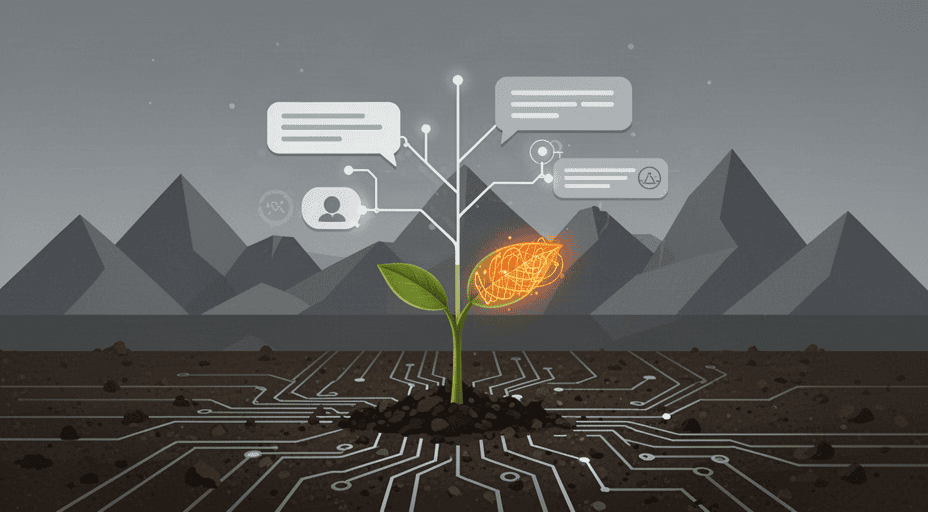
AI Dependence Is Changing How Small Businesses Make Business Decisions
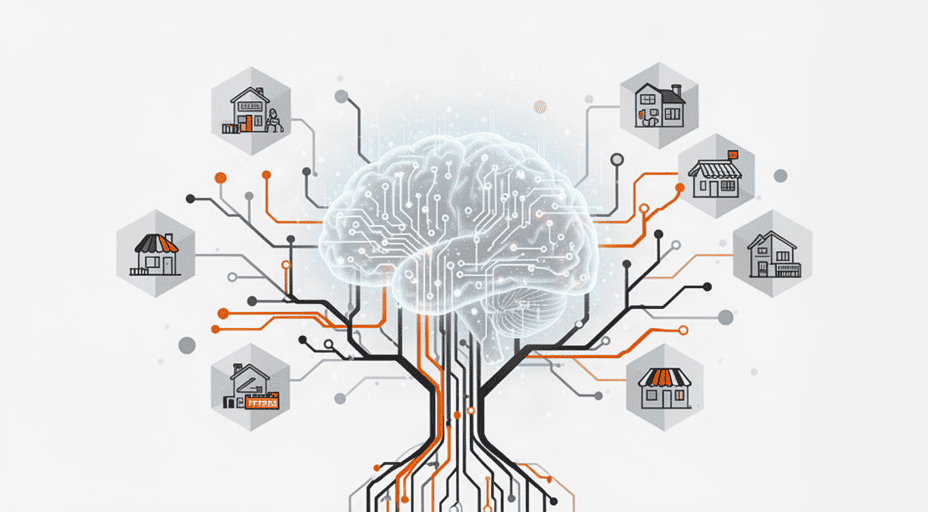
The smoother AI responses become, the less small business owners question “why.”
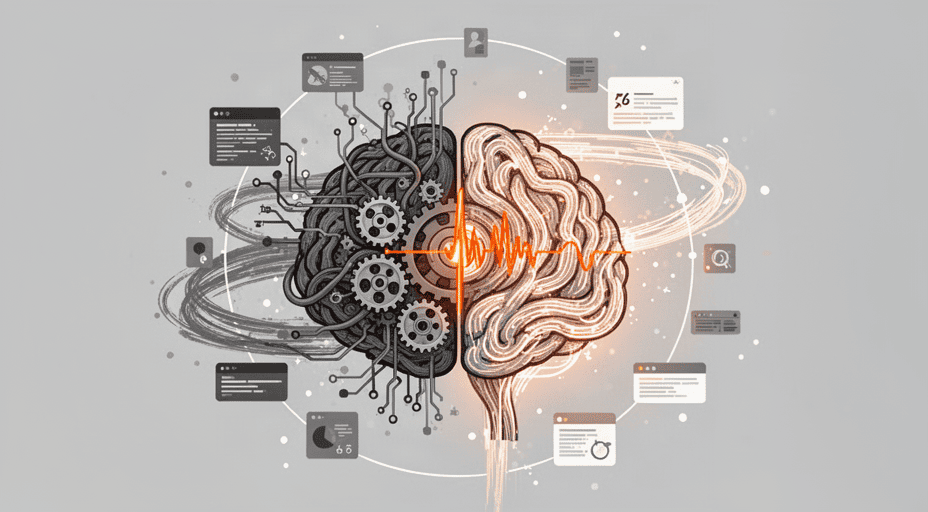
AI dependence does not just accelerate decision-making. It is quietly reshaping the role of intuition in the executive room.
Many small business owners now open their AI assistant before opening spreadsheets. They no longer ask employees, partners, or even themselves. They ask the machine.
The concern is not that AI is wrong. The concern is that people no longer recognize when they’re trusting an unverified answer.
The Illusion of Certainty and the Erosion of Intuition
In the past, small businesses relied on intuition to fill data gaps. Owners sensed the market through customer feedback, sales calls, and repeat visits from loyal customers.
Now, AI fills that gap with a confident paragraph. Instead of sensing, people query. This is a fundamental shift in decision psychology.
The problem is this: intuition used to be the final layer of critical scrutiny. When AI replaces intuition, small businesses lose their last defense against irrational decisions.
Key point: Every AI recommendation is a lossy compression of data. If you don’t request the hidden assumptions, you’re only seeing the comfortable part of the data.
The consequence is that small businesses easily fall into a state of making decisions that appear data-driven, yet cannot trace back the reasoning.
The Nature of Business Decisions with AI Intervention
To understand how AI changes things, we need to break down a business decision into four components. Each is being altered by AI in a different way.
Input data compressed into summaries
A business decision usually starts with raw data: cash flow, customer feedback, browsing behavior, shipping costs, seasonality. AI tends to convert this data into a neat summary paragraph.
A summary is not raw data. It’s a lossy compression. Every outlier, weak signal, or unusual detail may be discarded.
For small businesses, outliers are often the most valuable clues. When owners only read summaries, they don’t see what was filtered out.
Inference logic being outsourced
Modern AI doesn’t just answer “what does the data say?” It answers “what should you do?” Users tend to accept the recommendation, especially when delivered in a confident tone.
The biggest risk isn’t that AI might be wrong. It’s that small businesses gradually lose the ability to explain why they chose a certain path.
When a bank asks why inventory increased, the answer is “AI said so.” A decision that cannot be challenged is no longer a business decision. It’s just an execution order.
Risk critique being blurred
AI can generate smooth, reassuring answers because it bears no legal responsibility for consequences. The small business owner, however, bears all the risk.
This responsibility gap is not clearly flagged by software. In practice, AI often buries its hidden conditions at the end, in small print.
But busy users only read the main recommendation. As a result, critical scrutiny is skipped precisely when it’s most needed.
Action delayed by query loops
The availability of AI creates a kind of questioning addiction. Instead of finalizing a decision, people ask one more question to feel more certain.
Each new query increases the illusion of deep analysis. But this loop is often just a way to avoid taking action.
Small businesses need fast decisions. Yet they get stuck creating endless comparison tables and simulation scenarios.
A Hybrid Decision-Making Model Between Human and Machine
The effective way to use AI is not to ask more questions. It’s to place AI within a controlled feedback loop.
The model has three stages. Stage one: AI generates a hypothesis from data. Stage two: humans search for evidence that contradicts the hypothesis. Stage three: AI adjusts the hypothesis based on that critique.
This model doesn’t make AI the decision source. It turns AI into a tool for generating counterarguments, while humans remain the arbiters.
Expert note: Never let AI conclude a decision without external contradictory evidence. If you can’t find such evidence, ask yourself whether you’re missing data.
Simulation Case: Kitchenware Company Kettle & Hearth
Kettle & Hearth, a kitchenware brand selling cast-iron pots and accessories via e-commerce, used AI to analyze three quarters of sales data.
The tool recommended increasing ad spending on cast-iron pots by 40%, citing higher-than-average conversion rates.
The business owner didn’t act immediately. They asked AI to list its hidden assumptions. The analysis revealed that AI assumed shipping costs would remain unchanged in Q4.
But the company had just received a fuel surcharge notice from its logistics provider. If they followed the recommendation, projected profit margins could drop below break-even.

They decided to increase ad budget by only 15%. The remainder was redirected to bundled lid discounts. Simulation results showed an additional $9,400 in quarterly revenue compared to the 40% budget increase scenario.
Key takeaway: AI analyzed data correctly but misunderstood operational context. Humans saw what the summary report didn’t show.
This case illustrates the value of the “challenge hidden assumptions” step. It’s not difficult, but most small businesses skip it, assuming AI has already considered everything.
Execution Strategy: Keeping AI on the Analytical Track
To use AI without losing decision-making capacity, small businesses need four mechanisms. These don’t require complex new technologies.
Classify decisions by maximum potential loss
If a wrong decision could cost under $500, allow more AI automation. If the maximum potential loss exceeds three months of cash flow, require human critique.
This classification isn’t meant to diminish AI’s role. It’s meant to direct the owner’s attention to the areas of highest risk.
Require AI to return logic and hidden assumptions
Every time you receive a recommendation, ask a simple question: “List the three assumptions in this recommendation. Which one is weakest?” This forces AI to reveal the compressed data.
Then ask AI to rewrite the recommendation as an “if… then…” statement. This structure ties outcomes to operational conditions, instead of issuing blunt commands.
Build proprietary data to reduce illusion
The more open an AI assistant is, the more likely it is to hallucinate when lacking business-specific data. Create an internal file containing pricing rules, customer feedback, and past campaign histories.
Upload this file before analysis. Then, AI won’t answer based on generic knowledge it will respond based on your business’s unique context.
Document decisions
When making a decision, record three lines: initial hypothesis, contradictory evidence, final decision. Documentation enables traceability when AI is wrong.
Store these records together. After several weeks, small businesses will start to see repeating patterns in AI errors. That becomes valuable training data.
Evaluation Using Tools and Scoring
Not every AI tool fits small businesses. Choosing the wrong one can increase dependence instead of reducing it.
Table 1: Comparison of decision support solutions.
| Solution | Strength | Limitation | Best for |
|---|---|---|---|
| General-purpose conversational assistant | Fast counterargument generation, customer simulation, document summarization | Prone to illusion without proprietary data | Fast decisions, low risk |
| Long-form analytical assistant | Detailed reasoning, sensitive to logical contradictions | Requires clear prompt frameworks | Legal analysis, contracts, pricing strategy |
| Real-time lookup assistant | Market information access, competitor tracking | Hard to separate from ad-driven data | Market research, competitive moves |
| Lightweight internal BI tool | Clean data, traceable formulas | Needs maintenance, slow updates | Cash flow, inventory, performance reports |
| Traditional spreadsheet | Flexible, familiar, easy to share | No reasoning layer, formula errors common | Budget planning, simple simulations |
The table shows no single solution replaces human decision-making entirely. Each tool excels only in part of the analysis chain.
Scorecard for AI Decision Readiness
Table 2: Scorecard for evaluating AI decision readiness.
| Criterion | Score | Notes |
|---|---|---|
| Ability to maintain critique | 7 | Needs a clear three-layer critique loop |
| Recommendation transparency | 6 | Many tools don’t display hidden assumptions |
| Input data reliability | 7 | Small business data is often noisy, needs cleaning |
| Implementation cost | 8 | Most tools offer free or low-cost plans |
| Owner autonomy | 6 | Easy to become dependent without decision logs |
Average score: 6.8 out of 10. This falls in the “Good” range, between 5 and 8.
This means small businesses can fully implement AI in decision-making. But to reach 9-10, they must improve recommendation transparency and owner autonomy.
The biggest weakness isn’t technology. It’s the habit of accepting machine output without demanding explanation.
Forecast 2027–2028: AI Agents and Accountability
By 2027, AI assistants will go beyond analysis. They will directly act: adjusting prices, placing orders, replying to customers, even drafting financial plans.
Small businesses will enter a race for proprietary data. Those who own clean, structured data will retain their ability to critique.
But the more automated systems become, the more accountability becomes a survival issue. If an AI agent places a wrong order, who is responsible? Without decision logs, small businesses won’t be able to trace the error.
The trend from 2027–2028 will be a split between disciplined and undisciplined businesses. The former will use AI as a smart intern always supervised. The latter will let AI think for them.
The gap between the two groups isn’t in tools. It’s in one simple question: “Which assumption in this recommendation could make me lose money?”
Conclusion
AI dependence isn’t a disaster. It’s a new channel, helping small businesses filter data at unprecedented speed.
But speed is only half of decision-making. The other half is knowing what you’ve discarded.
Small businesses don’t need to avoid AI. They need to turn AI into a tool for critique not a source of truth.
Key takeaway: When AI answers too quickly, slow down by one beat. That pause is where the decision-maker finds shelter.
Related Posts
AI Marketing for SMEs: Why Small Businesses Prioritize This Area

The AI Revolution Is Lowering Software Development Barriers to Nearly Zero, Unleashing an Unprecedented Wave of Indie Hackers
Founders Are Using AI to Scan Reddit for Real Customer Problems Before Writing a Single Line of Code

AI Solves the Staffing Shortage Puzzle: How Small Businesses Can Scale Without Hiring More
Why Content Creators Are Burning Out from Packed Posting Schedules and How to Build an Automation System That Preserves Creative Quality