DeepSeek V4 Flash and MiMo V2 Pro: Why Is the AI Market Seeing the Dominance of 'Cheap' and 'Extremely Fast' Models in Q2 2026?
I. Shocking Numbers and Common Cognitive Biases
1. A Crude but Powerful Metric: Cost per 1,000 Inferences
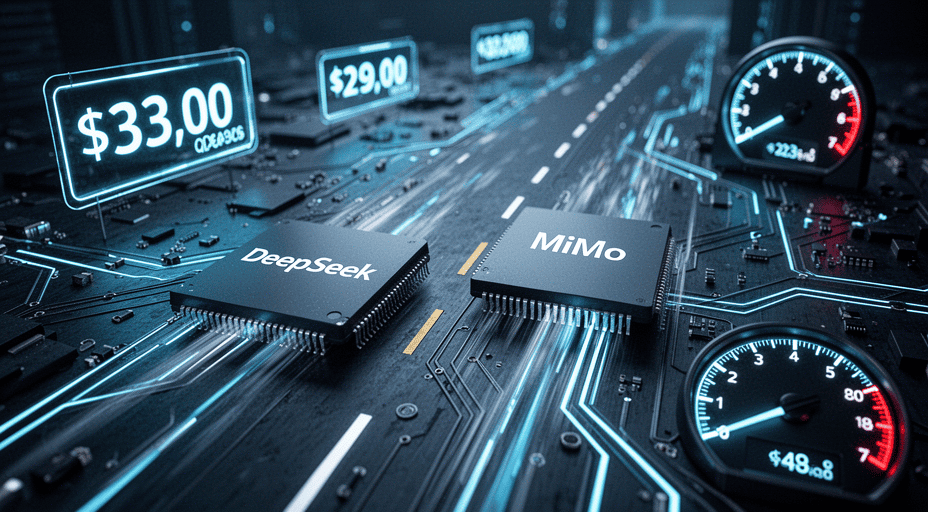
In Q2 2026, a new metric has become the industry standard: Cost Per Thousand Inferences (CPTI). This is the cost in USD for a model to complete 1,000 full inference (reasoning) operations. At this point in time, DeepSeek V4 Flash achieves a CPTI of approximately $0.002, while MiMo V2 Pro is even lower at $0.0018. This figure delivers a powerful blow to major platforms selling inference packages at $0.02–$0.05 for the same workload. A 10x–25x cost gap is not a minor optimization—it’s an economic overthrow.
2. Debunking the Two Most Dangerous Cognitive Biases
Bias #1: “Old technology, low cost—quality must be worse.”
This is the most dangerous fallacy, based on the assumption that performance is linearly proportional to cost. The reality dismantles this: Inference is not a uniform “magic” process. It’s a sequence of mathematical operations on tensors. A traditional large model, such as GPT-5 Turbo, is built with a vanilla transformer architecture, requiring a high number of FLOPs (Floating Point Operations) per generated token. New models like V4 Flash and MiMo V2 Pro aren’t “worse”—they are architecturally different. They leverage techniques such as highly optimized Mixture-of-Experts (MoE), extremely efficient distillation from large to small models, and most importantly, a frozen and simplified computational graph tailored for specific task scopes. They aren’t good at everything, but for the right tasks, they are absurdly fast and cheap.
Bias #2: “The market will quickly revert to expensive, powerful models.”
This bias ignores the economic reality of diminishing marginal utility. When quality reaches the good-enough threshold for 80% of daily commercial tasks (information summarization, simple code generation, customer support, basic data analysis), the business focus shifts from “most powerful” to “most efficient.” Cost and speed then become existential competitive advantages. No business wants to pay $10 for a task when they can pay $0.01 for an equivalent result—even if the cheaper option is slightly less “intelligent” in subtle ways that end customers never notice.
Key Takeaway: The current dominance isn’t due to cheaper models being inferior—it’s because they were redesigned from scratch for a new economic goal: CPTI. And the market, guided by diminishing marginal utility, has voted with its wallet.
II. Breaking Down the Problem: First-Principles Analysis
To fully understand the phenomenon, we must deconstruct it into its primitive components.
1. Primitive #1: Actual Computational Cost per Operation
At the lowest level, the cost of one inference is determined by:
- The number of parameters activated per token. Mixture-of-Experts (MoE) models only activate a small fraction of their tens of billions of parameters.
- Hardware efficiency. New models are designed to run optimally on inference-dedicated chips, such as Groq’s ASICs or GPUs with deeply customized inference engines, maximizing memory bandwidth utilization.
- Execution software efficiency. The software stack determines what percentage of the hardware’s potential is actually leveraged.
2. Primitive #2: Latency in User Experience
Time To First Token (TTFT) and Inter-Token Latency (ITL) are critical metrics. A “fast” model isn’t just about high throughput—it must achieve TTFT < 200ms and ITL < 50ms, creating a “real-time” feel. This requires:
- Highly sophisticated pipelining and batching of input data.
- Intelligent model sharding across multiple chips to minimize data transmission delays.
- Sparse activation, skipping unnecessary parts of the model during inference.
3. Primitive #3: Profit Margins and Business Models
This is the decisive factor for survival. A low-cost inference engine doesn’t mean zero profit. The secret lies in:
- Reaching sufficient scale to amortize development costs of the software stack and customized chips.
- Building an end-to-end optimized pipeline, from request intake to result delivery, eliminating all redundant bottlenecks.
- Freemium or bundled business models, packaging services with management software, analytics, and security, selling value-added services rather than raw computation.
4. Primitive #4: Enterprise Buying Behavior and Psychology
After the wave of expensive, failed Proof of Concept (POC) projects in 2024–2025, CTOs/CIOs now exhibit strong risk-aversion. They no longer want to bet on one oversized, expensive model for everything. Instead, they prefer a portfolio of models—each cheap enough and fast enough for specific tasks. This “one model per task” approach creates massive demand for thousands of instances of low-cost, fast models.
III. Rebuilding the Model: Atomic Architecture and Pipeline Design
From the primitives above, we reconstruct how platforms like DeepSeek and MiMo operate to gain an advantage.
1. Content Architecture: The “Asphalt and Gravel” Strategy
- Asphalt: Flagship large models (e.g., DeepSeek V3 Pro), used for complex creative tasks or multi-step reasoning requiring deep logic. They account for 5% of total inferences.
- Gravel: Flash, fast, cheap models (V4 Flash, MiMo V2 Pro), designed for repetitive, structured tasks. They handle 95% of inferences. Revenue from “gravel” is what funds the R&D of “asphalt.”
2. Atomic Pipeline: A Closed-Loop Inference Lifecycle
1. Request Analysis (0.5ms): A tiny router model identifies the task type (summarization, classification, text generation, etc.) and dispatches it to the appropriate “gravel” model.
2. Pre-processing (1ms): Tokenization and input data conversion into tensors.
3. Fragmented Inference (3–5ms): An MoE model activates only the relevant part on a chip cluster—only task-specific components are “awakened.”
4. Output Generation & Post-processing (2ms): Detokenization, safety checks, formatting.
5. Logging & Learning (background): Inference data is anonymized and used to fine-tune routers and child models, enabling continuous self-improvement.
Key Takeaway: Competitive advantage lies not in a single model, but in the entire ecosystem around it: routers, pipelines, software, and continuous learning mechanisms.
IV. Detailed Execution Strategies
1. Strategy for Startups and Small-to-Medium Businesses (SMEs)
- Immediate Action: Stop running POCs on expensive flagship models for all experiments. Use DeepSeek V4 Flash or MiMo V2 Pro APIs for all product development and testing phases.
- Deployment Strategy: Start with a “Model-as-a-Service” architecture. Build your system with a middle abstraction layer that calls APIs from multiple providers. Start with 100% traffic routed to cheap flash models. Only if a specific task exhibits error rates or subpar output above a threshold (e.g., >5%) should you route that task to a larger, more expensive model.
- Expert Note: Don’t evaluate models by “general intelligence.” Create internal benchmarks with 50–100 questions/images/code snippets representing the actual problems your customers face. Run this benchmark weekly on your models. Only CPTI and benchmark pass rates are the true truth.
2. Strategy for Independent Developers (Indie Devs)
- Learn Once, Deploy Everywhere: Deeply study MoE and sparse activation documentation. Learn how to fine-tune a compact adapter on a flash model for your task—instead of fine-tuning an entire large model.
- Build “Atomic” Products: Design your product as a chain of micro-tasks. Each micro-task is assigned to the cheapest and fastest flash model capable of handling it. Total cost will be extraordinarily low.
- Maximize Caching: With flash models, re-inference on identical inputs is extremely fast and cheap. Implement a semantic caching system. When users ask similar questions, respond from cache instead of calling the API—saving nearly 100% on recurring queries.
3. Strategy for Enterprise AI/ML Teams
- Challenge: Not cost, but governance and compliance.
- Solution: Build an Internal AI Gateway.
- Gateway: Deploy an internal inference gateway. All departmental requests flow through here.
- Policy Engine: Set policies. Example: “All data containing customer IDs must go through Model A (self-hosted, more expensive, GDPR compliant). Internal marketing requests may use flash Model B (cheap, fast, cloud-based).”
- Observability: Monitor costs, latency, and output quality per model and per department.
- Supplier Diversification: This gateway lets you easily add or remove flash model providers without changing code in downstream systems.
4. Pricing and Bidding Strategies Based on CPTI
- For Service Providers: If you sell AI-infused products, stop selling by “API calls” or “users.” Start selling by “completed tasks.” For example: “Package: Analyze 10,000 legal documents—$20,” instead of “Pro API Access: $100/month.” This model is transparent, easy to understand, and directly reflects your value. Price = CPTI × number of tasks + profit margin.
- For Buyers: When bidding, require vendors to disclose committed CPTI and committed TTFT/ITL for core tasks. Include these metrics in Service Level Agreements (SLAs). This forces the market to compete on real efficiency, not buzzwords.
V. Comparison Table and Performance Evaluation
1. Comparison of Solutions/Tools
| Criteria | DeepSeek V4 Flash | MiMo V2 Pro | GPT-5 Turbo (Reference) | Self-Hosted Llama 4 70B Solution |
|---|---|---|---|---|
| CPTI (USD/1000 inferences) | ~0.002 | ~0.0018 | ~0.03 | ~0.05 (including infrastructure) |
| Time To First Token (ms) | 180 | 160 | 400 | 600+ |
| Inter-Token Latency (ms) | 35 | 30 | 50 | 70 |
| Primary Architecture | MoE 128 experts | MoE 256 experts | Dense Transformer | Dense Transformer |
| Strengths | Balanced speed, cost, and output quality. | Extremely fast, lowest cost. | Superior output quality on complex, logic-heavy tasks. | Full data control, deep customization. |
| Weaknesses | Requires careful routing for complex tasks. | Output can be “shallower” for philosophical queries. | High cost, high latency. | Very high operational and maintenance costs. |
| Business Model | API, Freemium | API, Freemium | API, Enterprise | Self-hosted |
2. Performance Scorecard (Scale 1–10)
| Criteria | Score | Notes |
|---|---|---|
| Economic Efficiency (CPTI) | 9 | DeepSeek and MiMo dominate on cost per task. |
| User Latency (UX) | 8 | TTFT and ITL meet “real-time” thresholds for most tasks. |
| Output Quality (for 80% of tasks) | 7 | Good enough and stable for summarization, classification, simple writing. |
| Scalability | 9 | Cloud-native architecture and hardware optimization enable rapid scale-out. |
| Flexibility | 6 | Excellent on optimized tasks, but weaker on novel, unseen tasks. |
| Safety & Compliance | 5 | Requires additional layers of governance and filtering from end users. |
| Ecosystem & Tools | 8 | SDKs, documentation, and developer support have matured rapidly. |
Score Interpretation:
- Average Score (for most use cases): (9+8+7+9+6+5+8) / 7 ≈ 7.4 / 10—a solid “Good.”
- Analysis: Excellent scores (9–10) go to Economic Efficiency and Scalability—core strengths. Good scores (5–8) cover Latency, Output Quality, and Ecosystem. Low scores (<5) belong to Safety & Compliance, highlighting end-user responsibility. A 7.4 total indicates these models are excellent default choices for business, but not a silver bullet.
VI. Future Trends and Conclusions
1. Outlook for Q3/Q4 2026 and Beyond
- The Micro-Model War: Ultra-specialized flash models will emerge for single industries (legal contract flash model, preliminary medical imaging diagnosis model), with even lower CPTI.
- Hardware Will Keep Leading: Differentiation among flash model providers will increasingly depend on proprietary chips and software stacks, not just model architecture.
- Rise of Edge Inference: Flash models will be packaged to run directly on end-user devices (phones, laptops, cameras), eliminating network latency and cloud costs for certain tasks.
2. Conclusion: The Era of Practical AI Economics
The dominance of DeepSeek V4 Flash and MiMo V2 Pro is no market accident. It’s the logical result of applying first-principles thinking to a maturing industry. These companies shattered the “bigger is better” assumption and instead optimized for real economic primitives: cost per computation, latency per interaction, and profit per business.
We are entering the Era of Practical AI Economics, where value isn’t in the grandeur of the model, but in the efficiency of the entire system around it. Businesses and developers who understand this—and build strategies around CPTI, atomic pipelines, and intelligent governance—will be the winners in the next phase. The game is no longer about who has the smartest model, but who can operate the most efficient AI inference network on the planet.
Related Posts

Why the Business Models of AI Apps Like OpenClaw, Hermes, and MCP Platforms Are Driving a Shift from the App Economy to the Agent Economy?

Three Latest Data Attack Vectors on AI Systems That Every Business Owner Must Know Before Delegating Control to Open-Source Models

Can AI Self-Evaluation Radically Transform the Way We Monitor Systems?

What Are the Boundaries in Modern Production Processes When AI Agents Like Cline Can Read Codebases, Fix Bugs, and Automatically Deploy to Cloud Platforms?
Cost Revolution: Why New Generation AI Chips Make On-Premise the 'Gold Standard' in 2026?