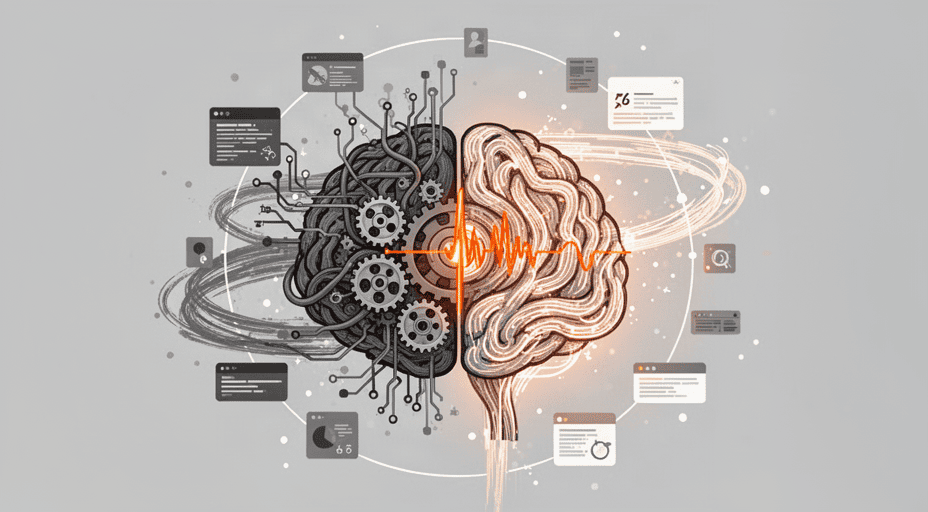
When Content Creators Are Burned Out From Packed Posting Schedules, What Smart Automation Solutions Exist for Them?

Misplaced Complaints
Most conversations about burnout in content creation point to a single cause: high publishing frequency. “I have to post two short videos every day, one blog post per week, three social posts—I can’t breathe.” But if we pause and examine the nature of the work, frequency is merely the surface layer.
An artisan crafting three chairs each week would burn out if they had to personally chop the wood, sand, polish, and paint each chair from scratch. However, an assembly line can produce ten chairs a day without any worker collapsing. The difference isn’t in the output volume, but in how tasks are organized and cognitive load is distributed.
Key Takeaway: Burnout does not stem from the quantity of content produced. It arises when the brain must process a long sequence of disconnected, repetitive tasks manually within a single work session.
Inside the Anatomy of a Content Production Unit
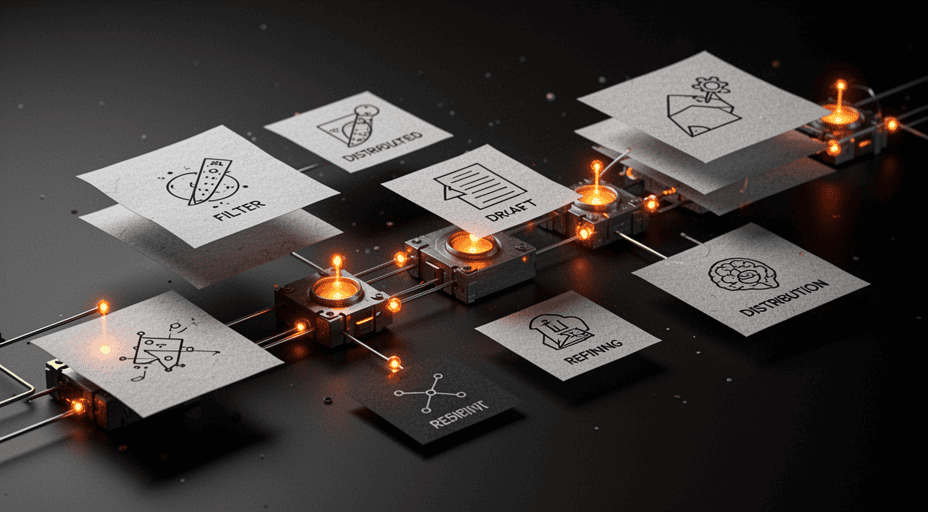
To understand why smart automation is the answer, we must first break down content creation into its fundamental layers. Almost any content format video, article, podcast, or graphic—passes through four distinct layers:
1. Signal Collection & Filtering Layer: Scouring inputs like industry news, audience questions, and social trends to crystallize ideas.
2. Rough Production Layer: Converting ideas into drafts, including outlining, scripting, rough recording, or preliminary design.
3. Refinement & Packaging Layer: Editing, error checking, tone alignment, adding subtitles, SEO optimization, and platform-specific formatting.
4. Distribution & Measurement Layer: Posting across channels, responding to initial comments, extracting metrics, and analyzing performance for future iterations.
Each layer consumes a different type of mental energy. Layer 1 demands open-ended thinking, Layer 2 relies on creativity, Layer 3 requires detail-focused concentration, and Layer 4 needs operational discipline. When a creator tries to jump across all four layers within just a few hours, the brain constantly switches context. This is precisely why content creators feel drained, even if their actual working hours aren’t longer than those in other professions.
Restructuring Operations: The Segmented Assembly Line Model
If we treat each layer as a separate station in a factory, the automation strategy isn’t about finding one machine to do everything. Instead, it’s about building specialized “virtual workers” for each station. This is the shift from the generalist creator to the Content Assembly Line Operator.
Station One: Self-Sustaining Ideation
Instead of straining to think of topics each morning, build an automated signal-gathering system. Connect tools like Google Alerts, industry RSS feeds, Twitter/X API (via SocialData or similar), and an AI summarization tool like ChatGPT or Claude Projects to run every 48 hours. A concrete workflow:
- Step 1: Raw content from sources automatically feeds into a Notion Database or Google Sheet via Zapier webhooks.
- Step 2: Run a standardized AI prompt: “From the 20 news headlines below, extract 5 counterarguments or 5 questions our target audience (include audience profile) might ask. Suggest 3 content angles for each issue. Maintain the tone of voice (insert tone template).”
- Step 3: Results flow directly into an “Idea Queue” column with a priority score (1–3 stars) based on relevance.
Now, creators spend just 5 minutes each morning reviewing pre-generated ideas instead of 45 minutes searching and brainstorming. Creative energy is preserved from the outset.
Station Two: Rough Production via Templating and Multimodal AI
From a selected idea, instead of writing everything manually, build “skeleton templates” for each content format. These aren’t rigid text models, but logical frameworks. For example, an industry analysis template could follow: [Data Context] -> [3 Key Arguments with Examples] -> [Expected Implications] -> [Specific Audience Action].
Then, integrate AI to draft content from the template:
- For articles: Use Claude Sonnet or ChatGPT-4o with system prompts that include tone guidelines, structure, audience profiles, and content restrictions.
- For video scripts: Input the idea into Descript or Notion AI to generate a rough script with B-roll suggestions. Tools like Runway Gen-3 or Pika (expected to mature by 2025–2026) may soon generate placeholder video directly from text during drafting.
- For graphics: Use Canva AI or Midjourney to generate draft visuals from text descriptions, bypassing heavy design software.
Expert Insight: Never let AI fully write on its own. Provide the “bones” first, then let AI add the “flesh.” A solid template specifies where data, anecdotes, or emotional elements belong. AI handles neutral structure and phrasing; the human adds personal experience. This way, the first draft reaches 70% quality in seconds.
Station Three: Editing with Automated Quality Gates
After the draft, most creators fall into manual cycles of sentence-by-sentence editing, spell-checking, and logic-reviewing. Automation can establish an AI-powered quality gate.
Instead of checking manually, configure an AI agent using tools like ChatGPT with Custom Instructions or a Claude Project to act as a strict editor. Upload the draft with an automatic checklist:
1. Spell and grammar correction.
2. Alignment with brand voice principles.
3. Flag unsupported claims and highlight sections needing citations.
4. Suggest cuts for redundant or wordy passages.
5. SEO check: keyword density, meta description.
Humans only step in at the final stage: reviewing AI suggestions, making final judgments, and adding personal insights only humans can provide. Editing time drops from 45–60 minutes to just 8–12 minutes per long-form article.
Important Note: Do not allow AI to directly edit the original file without human review. Using a “suggest edits” mode (like track changes) is far safer.
Station Four: Automated Distribution and Learning
The final layer is often the most silently draining: posting across five platforms, resizing images, running A/B headline tests, and constantly refreshing for metrics.
- Distribution: Use tools like Buffer, Hootsuite, or a Make.com (formerly Integromat) workflow to connect your blog’s RSS feed to social media. When a blog is published, the system automatically extracts the title, featured image, and a two-sentence summary via ChatGPT API, then posts to LinkedIn, Facebook Pages, and Twitter/X. For video, Repurpose.io can automatically convert a long video into 3–5 short clips with subtitles.
- Measurement: Set up an automated dashboard in Looker Studio connected to native platform APIs. Weekly, a natural-language summary report is emailed or sent to your personal Slack, highlighting the top 3 performing pieces, the worst performer, and two emerging trends from comments. Creators no longer need to constantly check social apps.
Case Study: The Transformation of NovaStream Media
To illustrate how these pieces work in practice, consider NovaStream Media, a fictional content agency serving 12 mid-sized business clients. Each client requires five blog posts and ten social posts monthly. The team of six handled everything—ideation, writing, editing, and posting.
After 8 months, three team members quit due to burnout. The remaining members worked 12–14 hour days, content quality declined, and client complaints surged.
Management decided to restructure the entire workflow into a Content Assembly Line. They invested in the four automation stations described, with a total tech stack cost of $400/month (Make.com, ChatGPT Team, Canva Pro, Buffer, API endpoints). After three months of stable operation:
- Time per blog post from brief to publication dropped from 3.2 hours to just 0.9 hours.
- Team roles became specialized: two managed Ideation and Rough Production, two focused on Polishing Edits, two handled Distribution and Client Support.
- The number of clients served increased to 18 without hiring new staff.
- Typos and factual errors nearly disappeared thanks to the AI Quality Gate.
The content lead at NovaStream reflected: “Before, I’d open my laptop in the morning feeling like I was stepping into a black hole. Now, I open the dashboard and see that the assembly line has already completed the rough work while I was asleep. My job is to read, think, and add flavor not spend hours typing.”
Comparing Solution Layers: From Manual to Fully Automated
Not all tools create equal value. The table below compares four levels of automation creators can apply, based on human intervention and cognitive load reduction.
| Automation Level | Representative Tools | Average Cost (USD/month) | Reduction in Manual Tasks | Core Characteristics |
|---|---|---|---|---|
| Fully Manual | No specialized tools | 0 | 0% | Humans handle all four stations. High burnout risk. |
| Scheduling & Basic Support | Buffer, Hootsuite, Trello | 15–50 | 15% | Automates Distribution only. Doesn’t impact production thinking. |
| Standalone AI Assistance | ChatGPT, Jasper, Canva AI, Descript | 20–100 | 45% | AI reduces drafting and design time but doesn’t integrate workflows. |
| Synchronized Assembly Line | Make.com + ChatGPT API + Notion + Dashboard | 150–400 | 85% | Stations communicate; data flows automatically. Humans review and enhance. |
Clearly, investing in the synchronized assembly line delivers a productivity leap, though it demands upfront systems design thinking. A cost of $150–400/month is reasonable for small agencies or stable independent creators.
Scorecard: Evaluating Comprehensive Smart Automation
For independent creators or small teams considering an assembly line model, the following scorecard helps quantify effectiveness across five core criteria. 10-point scale.
| Criterion | Score | Notes |
|---|---|---|
| Cognitive Load Reduction | 9 | Separating task layers prevents constant context switching. Creators maintain flow state longer. |
| Content Quality Maintenance | 8 | Quality stays high with strong Quality Gates. However, without tight templates and oversight, content may become generic and lose personal tone. |
| Scalability | 10 | To double output, you only need to scale API budget and machine resources—not hire twice as many people. A fundamental structural advantage. |
| Technical Implementation Difficulty | 5 | Requires automation setup skills (Zapier/Make) and structured prompt writing. System thinkers adapt quickly; others may struggle initially. Expect a 2–4 week learning curve. |
| Monthly Operating Cost | 7 | At $150–400 for a full stack, this isn’t low for beginners. But when measured against hours saved, ROI exceeds expectations after month two. |
| Average Score | 7.8/10 | The system delivers breakthroughs in productivity and mental health, but has initial technical and financial barriers. |
Scoring Guide:
- 1–4: Fails basic needs, adds unnecessary complexity.
- 5–7: Meets goals but with notable trade-offs.
- 8–10: Superior solution that eliminates most root problems.
The low score on “Technical Implementation Difficulty” (5) shows this solution isn’t for everyone. It demands creators invest time upfront in “sharpening the axe” to later “cut wood” effortlessly. This is an investment in process design—a survival skill in the 2025–2026 creative economy.
The Road to 2026: AI Agents and the Rise of the Personal Mini-Factory
By Q3 2026, AI agents capable of planning and tool use are moving out of labs and into real-world use. This trend will reshape content creation in a clear direction: no longer requiring creators to spend two weeks learning Make.com.
Instead, you’ll simply say in natural language: “Every Monday morning, check my five industry newsletters, pick the three topics with the most lively comments, draft three blog outlines in the analytical style of my latest published piece, and send them to my Notion.” An AI agent acting as a “plant manager” will coordinate smaller worker AIs to execute the entire workflow—no need to drag and drop a single Zapier module.
At that point, the Content Assembly Line model retains its core architectural value, but technical barriers will approach zero. Genuine creators will return to their true role: Creative Directors of their personal brands, not diligent workers typing for eight hours a day.
Conclusion: Automation as Self-Preservation
Burnout in content creation is not a badge of honor or an inevitable price for success. It’s a warning signal that the current operating model is outdated one where the brain is forced to mimic a sequential processing machine, a role it performs poorly. Smart automation, through a segmented assembly line model, is fundamentally about redesigning the work environment to align with human biology: minimizing context switching and reserving high-level cognitive energy for critical thinking and creativity.
The real challenge isn’t how to post more every day. It’s how to end each day still alert and eager to nurture the next idea. Today’s tools Make.com, ChatGPT, Buffer, Claude are already powerful enough to make this possible. The only remaining hurdle is the willingness to leave behind the old mindset of “I must do it all” and step into the role of a creative systems architect.
Related Posts

AI Dependence Is Changing How Small Businesses Make Business Decisions

AI Marketing for SMEs: Why Small Businesses Prioritize This Area

The AI Revolution Is Lowering Software Development Barriers to Nearly Zero, Unleashing an Unprecedented Wave of Indie Hackers

Founders Are Using AI to Scan Reddit for Real Customer Problems Before Writing a Single Line of Code

AI Solves the Staffing Shortage Puzzle: How Small Businesses Can Scale Without Hiring More