A Programmer Built Vein, an Automated Tool Scanning Reddit, Hacker News, and Indie Hackers to Detect Recurring Complaints and Turn Them into Business Opportunities
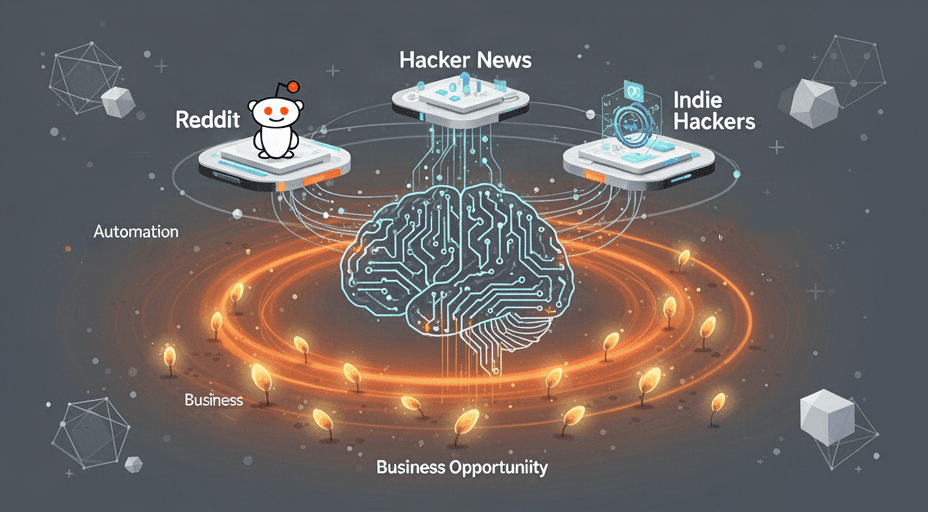
Most people believe a startup begins with a brilliant idea. In reality, ideas born in isolation often fail because they solve non-existent problems. The market doesn’t need another note-taking app or another AI chatbot. The market needs someone who listens to people’s daily frustrations and turns them into products. Vein is not just an idea-finding tool. It’s a system that collects raw pain signals from three of the most technology-dense online communities: Reddit, Hacker News, and Indie Hackers. When a lone programmer built Vein, he tapped directly into a stream of unmet demand. This article dissects the thinking behind Vein and shows how you can apply the same principle to start a business without guessing.
Where market signals truly lie
Every purchasing decision begins with discomfort. When someone posts on Reddit complaining about a missing feature in Notion, they’re not just venting. They’re emitting a signal that existing solutions don’t meet their expectations. If that same complaint appears dozens of times across different posts, you’re looking at a measurable market gap. Vein is essentially a noise filter designed to detect these repeating signals.
But before diving into how Vein works, it’s important to understand the type of human data it targets. On public forums, users typically express three main types of sentiment: feature requests, bug reports, and complaints about user experience. The first two are usually tied to specific products; the third is the real goldmine. When someone says, “I hate spending three hours every week reformatting reports from Excel to PowerPoint,” they’re describing a manual, time-wasting process. If that same sentence appears in r/dataisbeautiful, r/consulting, and Indie Hackers, it’s highly likely a group of people would pay to eliminate that pain.
Vein doesn’t perform academic-level semantic analysis. It operates on the principle of matching high-frequency patterns. Phrases like “I hate” or “sucks” combined with a noun referring to a tool or task serve as input signals. Keyword sequences that appear above a certain threshold across multiple subreddits or Hacker News threads are flagged. Crucially, Vein doesn’t need deep contextual understanding it only needs to count how often a pain point is repeated and compare it against the saturation level of existing solutions.
The internal architecture of an idea-finding machine
To build a system like Vein, you need to master four processing layers: data collection, coarse filtering, clustering, and market matching. Each layer acts as a different filter, removing noise and preserving valuable signals.
Data Collection Layer: Extracting raw data from open sources
Reddit, Hacker News, and Indie Hackers all offer public APIs or can be scraped via RSS/JSON feeds. Reddit provides a free API that allows real-time retrieval of posts and comments from subreddits. Hacker News has an official API hosted on Firebase, returning post IDs, scores, and comments. Indie Hackers offers several public endpoints for posts and products.
One important note: not all subreddits are commercially valuable. Subreddits like r/technology, r/programming, r/startups, r/smallbusiness, and r/entrepreneur typically host users willing to spend money. In contrast, r/funny is mostly useless. Vein’s data collector must be routed specifically to communities with clear buying intent.
Coarse Filtering Layer: Detecting negative sentiment and complaint patterns
Once raw data is collected, the next step is identifying actual complaints versus casual conversation. A simple method uses a list of negative keywords: “frustrated,” “annoying,” “waste of time,” “I wish,” “why isn’t there,” “there must be a better way.” Small language models (SLMs) can run locally to classify sentences quickly without API costs. Vein might use a fine-tuned DistilBERT model to label inputs as “complaint” or “non-complaint.”
Clustering Layer: Grouping similar pain points
A single complaint is meaningless. But when 50 people say, “I hate syncing data between my CRM and email marketing tool,” a pattern emerges. Vein uses text vectorization (embedding) and unsupervised clustering techniques like DBSCAN to group similar sentences. Clusters with member counts above a threshold say, 30 mentions in a month are flagged as potential business opportunities.
Market Matching Layer: Checking if anyone has solved it already
This is the decisive step. A widespread pain point with 10 existing solutions isn’t an opportunity. Vein automatically searches Google, Product Hunt, and G2 to count how many current tools target the issue. If results are sparse or existing products have low ratings (under 3.5 stars), it’s a strong signal.
From theory to practice: Simulating a product launch campaign
The case of NexBoard – a fictional company
NexBoard is a team of three searching for a SaaS idea. They decide to build their own version of Vein, focusing on subreddits for digital marketers: r/marketing, r/SEO, r/PPC, along with Indie Hackers and Hacker News. After three weeks of scanning, they notice a recurring complaint: “I spend too much time creating ad performance reports for clients from Facebook Ads, Google Ads, and TikTok Ads.” This phrase appears 47 times in one month across multiple forums.
When checking competitors, they find tools like Supermetrics and DashThis, but most are complex, expensive (starting at $99/month), and poorly support TikTok Ads. Reviews on G2 complain about cluttered interfaces. NexBoard decides to build a clean dashboard that automatically generates PDF reports by connecting just three ad accounts, priced at $29/month. They name it AdReportly.
Within two weeks, they build an MVP with just one report template. Then, they return to the original Reddit threads not to spam, but to comment: “I’ve had this issue too, so I built a small tool. Would appreciate your feedback.” Result: 50 sign-ups within 24 hours, 12 converting to paying customers within a month. NexBoard didn’t run ads or guess what the market wanted. They simply listened and responded.
Battlefield insight: The biggest mistake inexperienced founders make is trying to create something “unique” that’s never existed. Real profit lies in finding a solution with clear demand that’s just poorly executed. Vein is just a tool to shorten the time it takes to find that demand.
Comparing business opportunity discovery methods

To understand Vein’s position, compare it with traditional and modern approaches.
| Method | How it works | Response speed | Signal/noise ratio | Implementation cost | Real demand accuracy |
|---|---|---|---|---|---|
| Manual customer interviews | In-person, phone, direct questions | Slow (weeks to months) | High | Low (but time-intensive) | High |
| Google Forms surveys | Sending questionnaires to email lists | Medium (days) | Medium | Very low | Medium (sample bias) |
| Social listening tools (Brand24, Mention) | Tracking brand or industry keywords | Fast (hours) | Low (high noise) | High (from $99/month) | Low (only captures opinions on existing brands) |
| Traditional keyword research (Ahrefs, SEMrush) | Analyzing search volume | Fast | Medium | Medium ($29–$99/month) | Medium (keywords don’t always reveal pain) |
| Vein-style systems (forum scraping, complaint clustering) | Automatically scraping APIs, NLP clustering, market matching | Near real-time (minutes to hours) | Very high | Low (if self-built) to Medium (if using services) | Very high (pain confirmed by many across multiple channels) |
The table shows Vein trades initial implementation effort (requiring programming skills) for superior speed and accuracy. The key shift isn’t technological it’s moving from “searching for ideas” to “filtering demand signals.”
Evaluating the capability of a system like Vein
Below is a scorecard for the Vein model, applied to a technical founder capable of building and operating it independently.
| Criterion | Score | Notes |
|---|---|---|
| Ability to detect unmet demand | 9 | High accuracy when clustering is correct, but still requires final human verification. |
| Data freshness | 9 | Real-time data from APIs, reacts immediately to emerging trends. |
| Technical feasibility | 6 | Requires NLP, API, and database management knowledge; self-building takes 2–4 weeks full-time. |
| Scalability to new markets | 8 | Easy to add new data sources (Twitter, Slack communities) but requires filter tuning. |
| Competitive barrier (how long before copied) | 4 | Simple idea, easily replicated; competitive advantage lies in speed of action and execution quality. |
| End-to-end automation potential | 7 | Can automate from scanning to reporting, but product-building decisions still require humans. |
| Ongoing operational cost | 8 | Low server and API costs ($50–$100/month if self-hosted), almost zero marketing budget in early stages. |
| Legal risk level | 7 | Data from public APIs, but must comply with platform terms, avoid over-scraping that causes overload. |
Total score: 58/80 (equivalent to 7.25/10). This is a highly effective approach, but not a “silver bullet.” It works best for developers who can build quickly and are willing to engage communities for validation and distribution. If you’re not a programmer, you can still apply the same process manually by spending 30 minutes daily reading top threads on Reddit and Hacker News, noting recurring complaint phrases.
Execution strategy for absolute beginners
Without Vein, you can still build a basic version within 48 hours. Here’s a concrete roadmap.
Day 1: Set up the data collection pipeline
- Register a Reddit account, create a Python script using the
prawlibrary to fetch the 100 most recent posts from target subreddits. - Use
requeststo call the Hacker News API and retrieve the 500 top posts of the day. - Save all titles and content to a CSV file or SQLite database.
Day 2: Filter and analyze
- Write a simple function to scan text for negative keywords: “I hate,” “waste of time,” “I wish there was,” “sucks,” “frustrating.”
- Manually group: copy these sentences into a spreadsheet and categorize them by theme (e.g., “project management,” “reporting,” “email automation”).
- Count occurrences per theme. If a theme appears more than 5 times across at least 2 sources, add it to your “opportunity” list.
Day 3: Validate and launch
- For each opportunity, search Google for “[problem] + tool” or “[problem] + alternative.” Check if the top 5 results are actual products. Read reviews to identify unresolved weaknesses.
- Select an opportunity with fewer than 3 strong competitors and negative feedback on usability or pricing.
- Join the original threads, ask questions to understand deeper, then build a simple landing page describing the solution and inviting sign-ups.
Important note: Don’t try to build a complete product immediately. Measure interest by email sign-up count. If fewer than 50 people sign up in a week, you may have chosen the wrong problem or communicated it poorly. Return to the analysis step and pick another opportunity.
Common blind spots and how to handle them
False pain: Phrases like “I hate manually updating software” might just be casual griping, not a willingness to pay. Detection method: check if anyone in the same thread mentions trying a paid tool. If not, the pain may not be strong enough.
Echo chamber effect: A hot issue on Hacker News might not reflect real-world demand. To avoid this, cross-check with Google Trends or non-technical forums like Reddit’s r/smallbusiness. If only tech people are complaining, the opportunity may be too narrow.
The “free solution” trap: Many people complain but aren’t ready to pay. Identify whether the complainer is a budget holder. On r/PPC, users are often ad managers with budgets and willing to pay for time-saving tools. On r/gaming, users complain about games but rarely buy productivity software.
2025–2026 trends: From personal tool to shared infrastructure
As large language models become cheaper and faster, building a personal Vein will become commonplace. Platforms like Vercel, Replit, and Railway now allow deploying Python apps with just a few clicks. Even non-specialist developers can use tools like GPT-Engineer or GitHub Copilot Workspace to build a data-scraping pipeline in a single afternoon.
What does this mean? Technical barriers will approach zero. Competitive advantage will shift from “who can build the tool” to “who acts fastest after receiving the signal.” Speed of MVP launch, ability to write persuasive messages on Reddit without being flagged as spam, and skill in refining products based on real feedback will become critical.
A new class of tools will emerge: “Idea Copilots” integrated directly into Slack or Discord, sending you a morning update: “Yesterday, 23 people complained about syncing calendars between Google Calendar and Notion. No direct solution exists under $10/month.” Founders will simply read, evaluate, and click “Deploy landing page.”
Vein isn’t a revolutionary product. It’s a milestone marking a shift in how we discover opportunities. Instead of sitting in a room and brainstorming ideas, we place a listening device into the market and wait for signals. It’s a less glamorous approach but one with a survival rate many times higher.
Note: Vein is used in this article solely as a real-world example of identifying business opportunities from market demand. The purpose is to explore the underlying mindset and methodology, not to promote or provide a guide to using Vein.
Key takeaway: Don’t try to be the person who comes up with the next big idea. Be the best listener. Every complaint online is an uncashed check. Your job is to find the valuable ones and sign your name to them with a product that solves the problem.
Related Posts

AI Dependence Is Changing How Small Businesses Make Business Decisions

AI Marketing for SMEs: Why Small Businesses Prioritize This Area

The AI Revolution Is Lowering Software Development Barriers to Nearly Zero, Unleashing an Unprecedented Wave of Indie Hackers

Founders Are Using AI to Scan Reddit for Real Customer Problems Before Writing a Single Line of Code

AI Solves the Staffing Shortage Puzzle: How Small Businesses Can Scale Without Hiring More