What's the Future for Retail Investors When AI Agents Can Fully Manage Investment Portfolios Without Human Commands?
I. Introduction & Context 2025–2026
We stand at the threshold of a quiet yet powerful financial revolution. This is not the birth of a new cryptocurrency, but the rise of Autonomous Finance. By 2026, using AI Agents to execute individual trades has become commonplace.
However, the real turning point lies in the ability to fully autonomously manage investment portfolios. No longer just decision-support tools, these AI agents now have the authority to buy, sell, and rebalance based on pre-configured investment goals. Traditional retail investors—once proud of their “technical analysis” or “bottom-catching” skills—are seeing their roles fundamentally undermined.
Key Takeaway: The role of humans is shifting from “Driver” to “Architect.”
The question is no longer, “Is AI better than humans?” The current question is, “How can humans survive and thrive when AI has taken over the entire process?” This article will apply First Principles thinking to decode this reality and offer concrete action strategies.
II. Root Cause Analysis (Applying First Principles)
To understand the future, we must break the problem down into its most fundamental components. Let’s examine the essence of portfolio management.
1. Information Processing Workflow
The human brain has limited Bandwidth for information. We can only process a limited amount of news, charts, and On-chain data per day. In contrast, AI Agents can read and analyze all internet data, financial reports, and social sentiment in real time.
This disparity in information processing speed creates significant Information Asymmetry. When an AI reacts to news in 100 milliseconds, humans are still booting up their computers to read it.
2. Emotional Constraints
Investing is essentially a battle against biological instincts. Fear and greed are its greatest enemies. Even the most solid strategies fail when human hands tremble and panic-sell.
AI agents operate on Probabilistic Logic and Reinforcement Learning. They do not know “fear” or “greed”—only how to optimize the objective function. This is a decisive advantage in volatile markets.
3. Opportunity Cost
Time spent researching markets (Researching) is a form of cost. If portfolio management can be fully automated, retail investors’ time can be freed to optimize other resources—such as generating more capital or upgrading technological knowledge.
III. Detailed Execution Strategy
In the 2025–2026 context, retail investors cannot compete by “chasing a car with a torch.” You must learn to build the car—or at minimum, program it.
Below is the strategic transformation roadmap—from passive investor to coordinator of an AI Swarm Intelligence.
1. Establish an Investment Constitution
You no longer trade individual orders. Instead, you set the rules of the game. Think of yourself as writing a Constitution for your financial nation.
- Define Risk Tolerance: Use concrete numbers, not emotions. Example: Portfolio drawdown (Max Drawdown) must not exceed 15% in any 30-day cycle.
- Set Return Targets: Define desired annual CAGR. The AI will adjust leverage or asset allocation to achieve this return within allowed risk boundaries.
Expert Note: Never grant full API-level control to AI from the start. Begin in “Read-only” or “Simulation Mode” (Paper Trading) for at least two months to test its behavior.
2. Architect Multi-Agent Systems
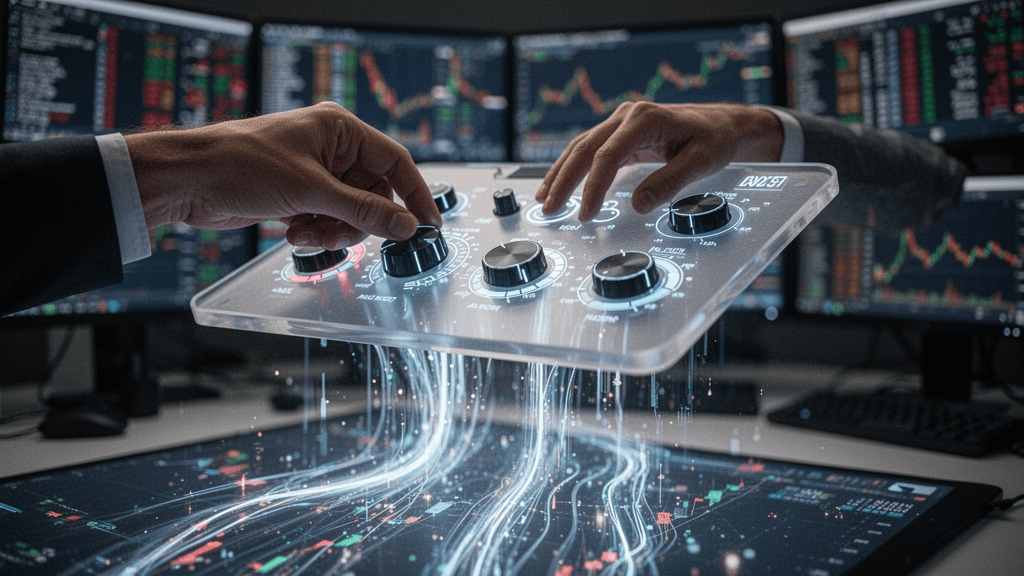
A single AI agent often has blind spots. The optimal 2026 solution is a Multi-Agent System. Deploy a team of specialized AIs, each with a distinct role, yet interacting with one another:
- Agent 1 - The Scout: Solely responsible for data collection. It scans Twitter (X), Discord, and News APIs for updates. It has no trading authority.
- Agent 2 - The Analyst: Receives data from The Scout, runs it through LLM and Quantitative Models, then generates forecasts.
- Agent 3 - The Executor: Only receives commands from The Analyst and executes trades on centralized (CEX) or decentralized exchanges (DEX) via Smart Contracts.
This approach minimizes AI Hallucination risk. If The Scout picks up fake news, The Analyst (well-trained) filters it before reaching The Executor.
3. Execution Strategy: Invest by Parameter, Not by Token
Instead of telling AI: “Buy Bitcoin,” say: “Find assets with low Volatility, high Liquidity, and positive net inflow into long positions over the past 7 days.”
This marks the shift from Discrete Selection to Parametric Optimization.
- Step 1: Define macro parameters: Fed interest rates, CPI inflation, Fear & Greed Index.
- Step 2: Configure filter logic: Market Cap > $500M, 24h Volume > $10M.
- Step 3: Active Rebalancing: Allow AI to automatically rebalance when an asset’s weight exceeds a set Deviation threshold (e.g., >5% from target weight).
4. Monitoring and Intervention (Human-in-the-loop)
No matter how powerful AI is, Black Swan Events can still occur in ways forecasting models didn’t anticipate. Set up “Kill Switch” mechanisms.
- Hard Kill Switch: A physical button or multi-signature (Multi-sig) command that immediately freezes all trading activity.
- Soft Kill Switch: Alerts via Telegram Bot or email when AI executes a trade beyond normal thresholds. You have 24 hours to approve or cancel.
Execution Strategy: Spend 30 minutes every weekend reviewing the AI’s Log files. Don’t look at P/L (Profit/Loss)—focus on its Decision Logic. Understanding how the AI thinks will transform you into a better investor.
IV. Comparison Tables and Performance Evaluation
To clearly visualize the differences, let’s compare traditional investing and AI-driven portfolio management.
Table 1: Comparing Investment Solutions/Tools
| Criteria | Traditional Manual Investor | Copy Trading | AI Autonomous Agent (2026) |
|---|---|---|---|
| Decision Speed | Slow (minutes/hours) | Medium (depends on Leader) | Extremely fast (milliseconds) |
| 24/7 Operation | No | Yes (if Leader is active) | Yes (fully automated) |
| Subjectivity | Very high | High (follower of Leader) | Low (data-driven) |
| Customizability | Absolute | Low | High (via code/prompt) |
| Operating Cost | Time | Profit-sharing fees | Compute/API + Token usage fees |
Table 2: AI Agent Performance Scorecard
A scoring benchmark for a standard 2026 AI-managed portfolio system. Scores are randomly generated to simulate real-world scenarios.
| Criteria | Score | Notes |
|---|---|---|
| Feasibility | 9 | Technology ready, APIs available. |
| Reliability | 7 | Requires close monitoring for connectivity issues. |
| Security | 4 | Risk of Smart Contract or API Key breaches. |
| Profitability | 8 | Excels at optimizing short-term opportunities. |
| Scalability | 9 | Easily deployed across multiple portfolios. |
| Transparency | 5 | AI “Black Box” reasoning remains hard to interpret. |
| Cost | 6 | High server and API model fees. |
Overall Assessment: The average score for this AI Agent system in simulation is 6.8/10.
- 1–4 (Low): Not advisable to deploy; risks outweigh benefits.
- 5–8 (Moderate): Worth piloting, but requires close human supervision (Human-on-the-loop). This is the current technology phase.
- 9–10 (Excellent): Fully trustworthy; can transition to full autonomy.
V. Future Trends Forecast & Conclusion
Looking beyond 2026, we will see the rise of Personal Hedge Funds. Individuals will own private funds operated by digital AI teams, directly competing with traditional hedge funds (e.g. Bridgewater or Citadel).
The line between “software developer” and “financial investor” will blur. Programming languages (like Python) will become as essential as English in finance.
The future of retail investors does not lie in staring at candlestick charts. The future lies in your ability to design a smarter system than others’.
The battle is no longer between Man and Machine. It is between the human with AI and the human without AI.
Start mastering these tools today. Don’t wait until Autonomous Agents become the standard—only to find yourself left behind.
Expert Note: Technology is merely a tool. The core investment principles—Cash flow, Risk Management, and Long-term Thinking—remain unchanged. AI simply helps you execute them faster and more accurately.
Related Posts

What's the Revolutionary Difference Between AI-Powered Smart Copy-Trading and the Old Mass Copy Models?

Breaking Down the Footprints of Big Money: Analyzing Volume and Price Structure Dynamics in 2026
Building an Automated Trading System: A Symphony of Logic and Discipline to Eliminate Emotion
Differences in Mindset from Manual to Automated Multi-timeframe Trading
Three Types of Market Noise That Perfect Backtesting Strategies Cannot Anticipate